In the most recent wave of the pandemic, the Omicron variant has resulted in seven days of virtual learning for Ontario students. Schools were closed to students for the first two days following the winter break and then opened to virtual learning at the last moment, leaving parents scrambling to find child-care or to support their children’s at-home learning.
Despite the fact that nothing has changed medically, students will be going back to school on Monday the 17th. As far as I can tell, this is a politically motivated move, because parents are fed up with having their kids home. The cynic in me thinks that it’s a calculated risk, with a high likelihood of closing schools again in the first week or two, when the healthcare strain and/or staffing shortages force us back online.
I understand the parental frustration – we are in an untenable position. Families are not designed to function this way. It is unsustainable to expect parents to work full time and also support children’s learning six hours a day. It is not reasonable to expect children to spend 225 minutes a day sitting in front of a screen, trying to learn without the usual benefits of in-person school.
That said, I find the anxiety around school closures frustrating, mainly because I find the arguments being made make no sense. I understand the economic need for children to be in school. Their parents need to work. For those parents who work outside the home, whether it be in healthcare, transportation, retail or other fields, childcare is non-negotiable. Staying home means losing income or job security. Something MUST be done to help these families weather the pandemic. These are often families who struggled even before the pandemic hit and it needs to be a priority to address their needs more wholistically.
But that is not the argument we keep hearing. The voices we are hearing are mostly from wealthier, more privileged families. These are parents who are working from home and struggling to perform their work duties while keeping their children focused on virtual school. They are people who feel their children are ‘falling behind.’ There is an outcry over the deteriorating state of children’s mental health.
The struggle to work and provide online school support is real. It is unreasonable and completely unsustainable. The expectation that parents would be able to perform both of these tasks is ridiculous and causing immeasurable stress on families in almost all situations. This letter, written by a private school principal, urging parents not to stress about the completion of school work, demonstrates the epitome of compassionate leadership. THIS should be the message we are sending families. We are living through a global emergency, the likes of which have not been seen in our generation, but somehow we have bought into the belief that things should carry on as usual.
The concern about children falling behind is ludicrous. Falling behind whom? We are ALL struggling, some more than others. Everyone’s learning has been disrupted. Everyone’s mental health has been challenged. We are in this TOGETHER, but we are still focused on competition and getting ahead. It also makes some bold assumptions about what actually happens in school, founded on very faulty beliefs about how children learn. I think one good thing that has come out of the pandemic is a heightened awareness for many parents of how broken the system really is. More on this later.
I am as concerned about the deteriorating state of children’s mental health as anyone. However, I am firmly unconvinced that the closure of schools is the catalyst for this. If being out of school were such a strain on children’s mental health, then we would see a spike in mental health issues and suicidality every summer. On the contrary, children’s mental health is usually at its best during the months that school is closed. Furthermore, children with mental health challenges often report that school is one of the major contributors to their struggle. Because of my family situation, I connect with many parents of neurodivergent children. Some of them are struggling more during this pandemic, but many are actually thriving. Being removed from the overstimulation, competition, and social frustration of school has been GOOD for them. Many parents have also embraced home schooling, or even unschooling, finding that their kids manage better with a more natural learning environment.
I contest that the decline in children’s mental health stems less from school closures and more from how we, as a society, are handling those closures. Imagine if we all said to our kids, ”Wow, how exciting! We get January to spend time in our jammies, play or go for walks outside, paint at the kitchen table, and get some extra screen time while Mommy and Daddy get some work done! What project would you do if there was nothing you HAD to do? What do you love and how can we get more of THAT?” Kids mental health would likely IMPROVE. Not possible for all families, I know, but our response is why they’re struggling. If we did more to support parents, I suspect we’d see a change.
The obvious piece that we are missing is that children are living through a global emergency, with parents and siblings who are also living through a global emergency, in a society that is living through a global emergency. There is trauma in that, with or without schools. Individual and collective trauma has been mostly ignored, mainly because of the requirement that we continue on as normally as possible. There hasn’t been space to process what is happening. There is an expectation that people will take on superhuman characteristics to keep all the balls in the air, despite obvious difficulties doing so. People have been asked to pivot to working from home, with a huge learning curve on technology. We’ve been asked to redesign the way we work, with neither warning nor infrastructure. On top of that, we’ve been asked to support our children’s learning, even while their teachers literally relearn how to do their jobs. There have been shortages of basic necessities, public upheaval, and regular news reports of death rates and infection rates daily for two years. People have been encouraged to fear others, to avoid friends and family, and to wear increasing levels of personal protective equipment for basic trips outside their homes. There are no sports, no destinations, and few opportunities to get away from those with whom we cohabitate. We have lived through lock downs, cancelled celebrations, and government advice that changes week to week, if not day to day. How is it possible that, in all of this, we are pinning children’s dysregulation on being out of school? Really? What magic elixir do you think we give out at school?
We are also missing the obvious stressor kids might feel about returning to school in the middle of a pandemic. While school may bring a modicum of normalcy to kids’ lives, it is a constant reminder of the dangers we are all facing. Wearing masks, heightened protocols, limited contact, no music – this is not school as usual. For kids with anxiety, or those who listen to the adults around them, the idea of going back into a potentially dangerous situation can be incredibly stressful.
But tonight took the cake.
Last month, the TDSB announced that during COVID, on days when inclement weather causes the cancellation of school buses, schools would be closed, because running schools during inclement weather often requires the mixing of cohorts. This news was generally well received by both students and teachers. This was exciting news, as usually the TDSB does NOT close schools, and teachers and students must find a way to get into school, rather than having the opportunity we all remember from childhood of “Snow Day!”
For several days now, we have been hearing reports of a winter storm on the way and a severe weather warning has been issued for our district. Tonight, just before 7pm, the school board sent out a message saying that in the event of inclement weather tomorrow, they would be reversing this new policy in favour of virtual learning tomorrow. At 7pm. On a Sunday night. Parents have already promised their children a snow day. Families have made plans to go sledding, build snow families, make forts, and have snowball fights. We’ve finally been given permission to have a relaxed day. Teachers have packed up their computers, made a mental pivot, and planned their return-to-school lessons. On the eve of one of the most stressful days of their lives, with no idea what to expect in school tomorrow, it looked like Mother Nature might give teachers a one-day reprieve.
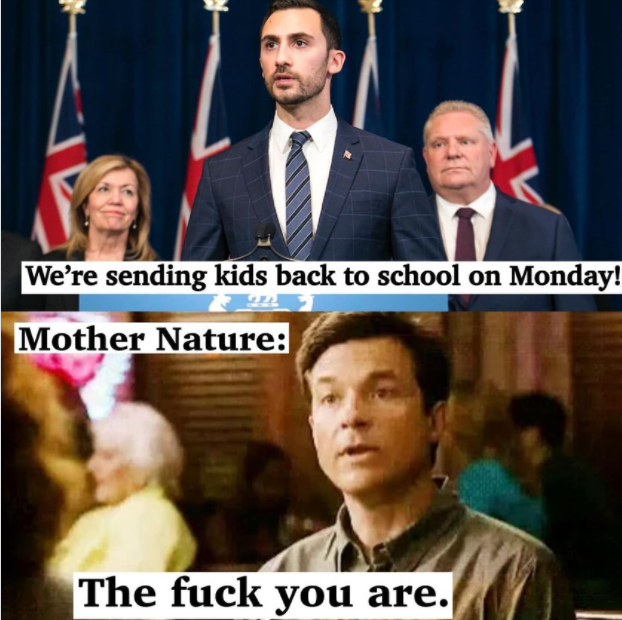
And then they changed the rules. Again. It makes me wonder who is making these decisions and on what grounds. Do they truly not understand how much work goes into planning? How complicated that pivot is? How stressful the return to school already is? How useless one extra day of virtual learning is, compared to the mental health benefits of having an unexpected day off to enjoy the wintry gift of a fresh snowfall?
Parents, please think about your options for tomorrow. Let’s rethink the messages we are sending kids. This will not be the last interruption this year. The coming weeks will be full of disruptions, last-minute changes, uncertainty, and frustration. Let’s ACTUALLY put mental health first.
What if we strayed just a bit from the status quo? What if we noticed that we are in the middle of a global emergency and reacted to that with compassion and grace? What if we gave kids a day off here and there? A day to unwind. A day to talk openly about what is hard about this crazy situation. What if we stopped expecting them to keep it all together and continue math and social studies as though there was some secret answer in the daily grind of those subjects? If we realized how random our expectations are and how much less likely kids are to fall behind if they are happy and motivated and mentally stable? What if we gave ourselves permission to let them play in the yard or watch another movie while we get that project done? What if we stop fighting them every step of the way and let them learn authentically, the way kids were meant to learn? School is not the only option, and certainly not the best option for many. During this time of educational unrest, we have a unique opportunity to try out different strategies, to play with our children, and to decide that mental health is indeed more important than conforming to the ridiculous expectations being laid out for us.
How can you put your mental health and that of your family first? How can we support each other through the disruptions coming in the next few weeks? How can we rethink the big picture and meet the needs facing us right now? I’d love to hear your thoughts. Stay tuned for more of mine.
 Out of the Well
Awesome post Amanda.
Sent from my iPhone
>
LikeLike
Thanks Joanne. What a fiasco. It just keeps going…
LikeLike
Hi Mandy,
I thoroughly agree that we all have to realize that children’s mental health is being impacted by living through a global pandemic. The usual indicators of school learning are not relevant at this time. The focus should be on supporting the mental health of the children. That will be the true measure of our success in dealing with the trauma that we are all experiencing. Your post was so well stated. Thank you.
Take care, Beverley
LikeLike
Thanks Beverley! It’s been really difficult to find the right balance while the expectations seem so focused on ‘normalcy.’
LikeLike